Written by Andrew K. Arnett
Recently, I had the profound pleasure of appearing on Matt Sergiou’s Talking Conspiracy aired on his long running Conspiro TV YouTube channel which specializes in the sublime matter of occult Beatles and related topics with media, the music industry and how this all warps into the mind bending military industrial complex and occultic webs that ensnare said agenda. Needless to say, this is a heady topic, and we diligently screwed on our thinking caps (not to mention the tin-foiled variety) and dove into the business with a certain aplomb, as befitting the circumstance.
The discussion centered on the year 1966, a most pivotal year for The Beatles and the world at large. The show was a panel discussion which included Sean MacLeod (author of Behind the Wall of Illusion. The Religious, Occult and Esoteric Worlds of The Beatles), host Matt Sergiou and myself.
As I discussed in the show, 1966 was a pivotal year for The Beatles and in general, for music itself. The touchstone for this pivot was The Beatles Revolver album. Released on August 5 of 1966, Revolver was a breakthrough on so many levels and certainly, popular music was never the same afterwards. It foreshadowed the psychedelic era of rock music that would commence in earnest in 1967, ie. the Summer of Love.
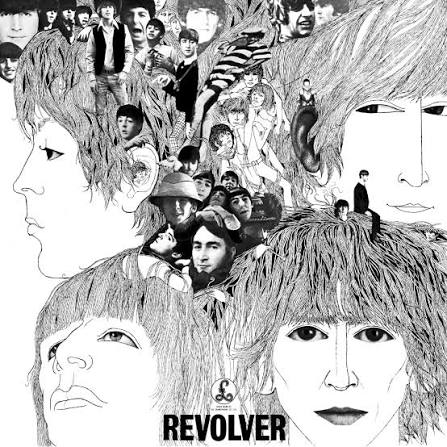
The cover art for Revolver was drawn by Klaus Voorman, an old friend of The Beatles from back in the Hamburg days. It features line drawings of The Beatles with old photos of The Beatles falling out of their hair which, according to Voorman, represents a “change in consciousness” for The Beatles. And change of consciousness it was, as by the time of the release of the album, all the members of The Beatles had already taken a magic carpet ride on the psychedelic drug LSD. As role models par-excellent, the youth of the world would soon follow suit and that, as was discussed during the show, may have been the intention from the get go.
Unlike some other Beatles album covers, Revolver isn’t widely known to contain many “Paul is Dead” clues. You know what I’m talking about, the clues that were sprinkled throughout Beatles album covers and songs indicating that the real Paul McCartney had (allegedly) died in a car crash on September 11, 1966 and was replaced by a (talented) body double. Nonetheless, there were still some clues bandied about. For instance, it was noted that on Revolver, all four faces of the Beatles were facing forward except for Paul, who we see in profile facing to the right. According to the theory here, this is the “old” Paul looking back on the past. The “new” Paul was to come next, with his technicolor vision of a psychedelic future to come. And indeed, according to Paul is Dead lore, this would be the last appearance of the original Paul on a Beatles studio album.
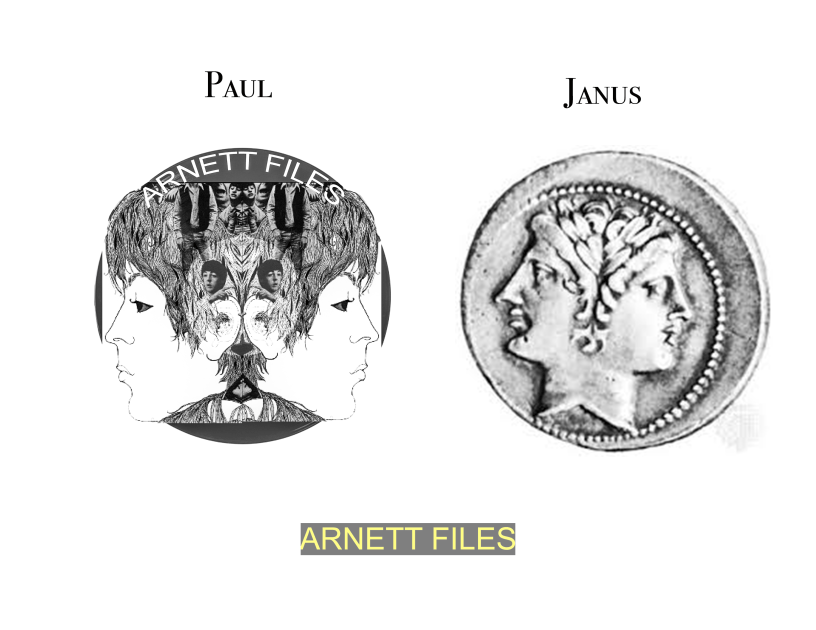
That was enough for me to get to work. As had been done on album covers like Sgt. Peppers where the image was sliced in half and then mirrored (interesting clues could be found in these mirrored images) I decided to do some slicing and dicing here, focusing on the profile of Paul—cutting that out and mirroring the image. This rendered an image that was, in my eyes, reminiscent of the ancient Roman coin depicting the god Janus.
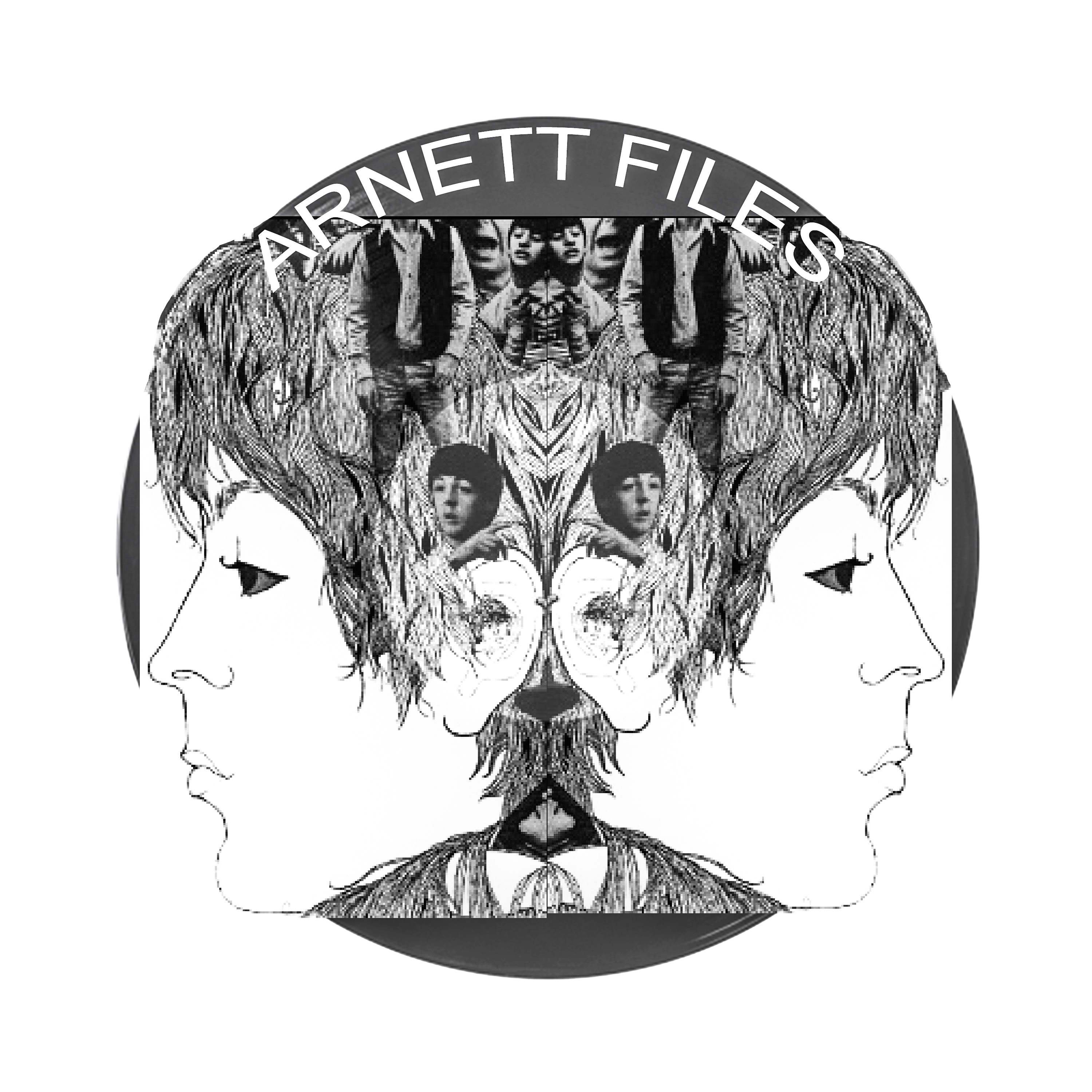
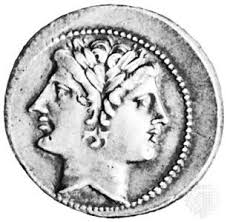
Janus is an intriguing deity to discuss especially in light of the Paul is Dead conspiracy, as he represents the two faced Roman god of doorways, gates, transitions, beginnings and endings. One face is gazing back towards the past, and the other towards the future. Indeed, the month January is named after Janus, as one face looks back on the year just passed and the other forward towards the year to come. In my opinion, the album Revolver can serve as a suitable emissary for Janus as it represents not only a transition musically for the Beatles but really, for the culture of the modern world as it was about to undergo a profound change in the years following 1966. And of course, the reference to the two Pauls—old Paul and Faux Paul—is hard to miss.
While I was researching this period for the show, I came across an interesting description of Revolver by Nicholas Schaffner who wrote in The Beatles Forever (1997), “where, when Dorothy discovers herself transported from Kansas to Oz, the film dramatically changes from black-and-white to glorious technicolor.” Voorman made a deliberate decision to render the cover of Revolver in black-and-white and there may be a reason for this. I would assert that if we put Revolver on The Wizard of Oz timeline, it would be right when the tornado is blowing into Kansas. Remember that at this point, the film is still in black-and-white. Indeed, Revolver represents the tornado itself, a whirling spinning force of nature.
When the house falls from the sky into the land of Oz, and Dorothy emerges from the house into Oz, the film turns into glorious technicolor. For The Beatles, this will take place in 1967 with the release of Sgt. Peppers Lonely Hearts Club Band. This is when the band lands in full psychedelic mode, and colorful album cover design reflects this. Everything before Revolver however, represents “Kansas.”
Interestingly enough, The Wizard of Oz is often associated with the mind control program named MKULTRA. It is suggested by some researchers that the imagery and plot of the film can be used as a trigger for psychological dissociation in subjects. For instance, the song “Somewhere over the Rainbow” represents the psychological fantasy land that subjects retreat into after experiencing trauma-based mind control techniques. As well, the concept of the “yellow brick road” indicates the necessary path that the victim must follow through on, regardless of the difficulties, as it is designated by the wizard (MKULTRA handler).
MKULTRA was noted for using copious amounts of LSD on its subjects and this album inaugurated, and subsequently normalized the use of LSD in the culture at large. It is a noteworthy consideration that an entire generation was submitted to a form of mind control spearhead by popular culture icons as in the case of The Beatles. These matters are delved into in greater depth in our show Talking Conspiracy. E.2: The Occult Beatles ’66 in’26 (With Sean MacLeod and Andrew Arnett). Watch it here:
Andrew K. Arnett is a writer for New Dawn Magazine and author of the novelThe Crowley Conspiracy published by Alien Buddha Press availableatAmazon. In his spare time he hunts ghosts with the Brooklyn Paranormal Society.
Find Andrew Arnett on X @AndrewArnett