This article by Andrew Arnett was first published at Substack on 28 February, 2022.
I’m in a coffee shop in the East Village. Drinking a large coffee. Reading the news. The news is not good. Early this morning, Russia launched a full scale attack on Ukraine.
Holy fuck.
Yes, for weeks now, there have been rumblings of war. Saber-rattling by Heads of State. Satellite images showing massive troop build up on the Russian/Ukraine border. But who actually thought it would come to this? I’m in shock. It doesn’t seem real. What are the implications? Ominous. A real game changer. The Great Chess Board has been reset. Thrown out the window even.
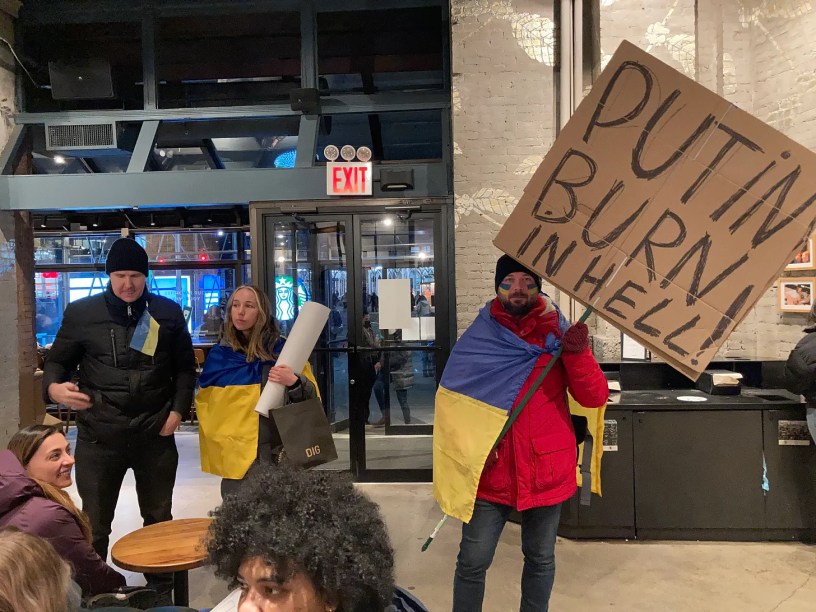
There’s a commotion coming from the front of the coffee shop. A group of war protesters have shown up with the Ukraine flag draped over their shoulders; carrying signs denouncing Putin. A young woman sitting at a table is crying. Is she crying about relatives in Ukraine? I don’t know.
There’s a big Ukrainian presence in this part of town. In fact, New York City is home to the largest Ukrainian expat population in the entire US. The popular Ukrainian restaurant Veselka is just down the street. Next to that is the Ukrainian National East Village Restaurant, serving the strongest drinks in Lower Manhattan. Many folks around here are understandably numb. Their country is under siege. Democracy itself is getting a vicious beat down.

What has transpired over the past 24 hours? From north to south, east to west, Russia has bombed almost every major city in Ukraine. They launched an amphibious assault on Odessa. Much of Ukraine’s air defenses have been taken out. Ukraine President Volodymyr Zelenskyy has confirmed at least 137 Ukrainian solders have been killed and 316 wounded. A fierce firefight is being waged over the airport just north of Kiev. Even more disconcerting is the Russian takeover of the Chernobyl nuclear power plant. Responding to reports of the capture of the nuclear facility, White House press secretary Jen Psaki told a news conference on February 24:
“We are outraged by credible reports that Russian soldiers are currently holding the staff of the Chernobyl facilities hostage. This unlawful and dangerous hostage-taking, which could upend the routine civil service efforts required to maintain and protect the nuclear waste facilities, is obviously incredibly alarming and gravely concerning. We condemn it and we request their release.”
Why would a burnt out nuclear facility, surrounded by a thousand square miles of uninhabitable land, be a top priority target for the Russians? We don’t know their ultimate goal but it is certainly strategically located, being on a direct path from Belarus to Kiev, the capital of Ukraine, sitting 80 miles south of Chernobyl.
On Thursday, after the Russian attack, monitoring stations in the area recorded an increase of radiation levels of about 20-fold. According to Ukraine’s State Nuclear Regulatory Inspectorate, the increase was caused by the movement of heavy military vehicles stirring up contaminated soil inside the 2,485 sq-mile exclusion zone surrounding the damaged reactor. The highest levels were found closest to the abandoned plant.
Nuclear materials expert Prof Claire Corkhill of Sheffield University told the BBC the increase was “quite localized” and that, “the increased movement of people and vehicles in and around the Chernobyl zone will have kicked up radioactive dust that’s on the ground.”
At that location, a normal dose would be three units (microsieverts) per hour. On Thursday, this increased to 65 microSv/hrs.

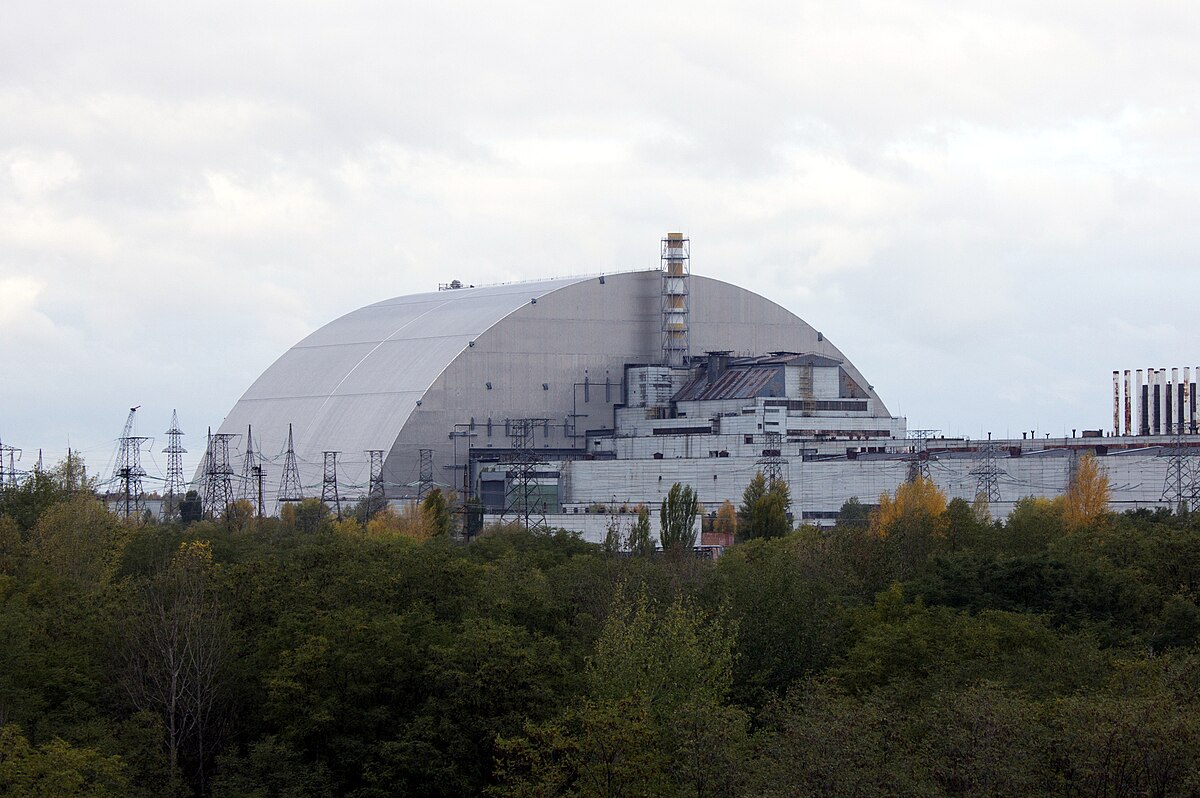
The bigger concern here is that fighting in and around the area could cause damage to the protective covering which surrounds the damaged reactor. God forbid that it should be struck by bullets, artillery or missiles, because experts warn this may release dangerous radiation smoke.
Chernobyl was of course the site of the worst nuclear disaster in world history, both in human casualties and cost. The disaster occurred on April 26, 1986, at the Chernobyl Nuclear Reactor Power Plant in reactor No. 4, located near the city of Pripyat in northern Ukraine, when it was part of the Soviet Union.
The disaster began when a series of events led to an uncontrolled nuclear chain reaction. The core melted and a number of explosions ruptured the reactor core, destroying the reactor building. This caused an open-air reactor core fire, releasing large quantities of airborne radioactive contamination over a 9 day period. Much of the fallout dropped over neighboring Belarus, about 10 miles away. 33 people died immediately, with some estimates showing 40,000 people hospitalized in the summer following the accident. Over 100,000 people were evacuated from the area, creating The Chernobyl Exclusion Zone covering an area of about 1000 sq. miles.
In December of 1986, the Soviets built the Chernobyl Nuclear Power Plant sarcophagus, a protective covering around the damaged structure, to contain the radioactive contamination. In 2019, Ukraine completed the New Safe Confinement (NSC or Arka). This is a mega-project with the specific goal of confining radiation leakage from Reactor 4 for the next 100 years.

Update: 28 February 2022
On Sunday, President Vladimir Putin raised the stakes on the Ukraine crises by ordering Russian nuclear forces be put on high alert. Putin noted “aggressive statements” by NATO and increased pressure from financial sanctions as reasons for the move, opening the way for the use of atomic weapons.
On Sunday, Jen Psaki told George Stephanopoulos on ABC’s This Week:
“This is really a pattern that we’ve seen from President Putin through the course of this conflict, which is manufacturing threats that don’t exist in order to justify further aggression — and the global community and the American people should look at it through that prism.”
The fact is that military action taking place in Ukraine right now is a game changer on so many levels. The nuclear specter has reared its ugly head and wants to drag us all back to the 1950s and the paranoid days of the Cold War. Loose talk of atom bombs exploding has, as of this past weekend, become the norm. And it’s not even Monday yet. Come on people, let’s get our shit together. There’s no sense in going down that tunnel. It is dark down there and the only thing that shines is a gleaming death head skull smiling.
References
Gill, Victoria (24 February 2022). “Chernobyl: Radiation spike at nuclear plant seized by Russian forces.” BBC. Retrieved 25 February 2022.
Fossum, Sam; Saenz, Arlette; Cole, Devan (27 February 2022). “White House responds to Russia’s decision to put deterrence forces on high alert.” CNN. Retrieved 27 February 2022.
Editors (Updated 23 April 2021). “Chernobyl.” History. Retrieved 27 February 2022.
 ARNETT FILES